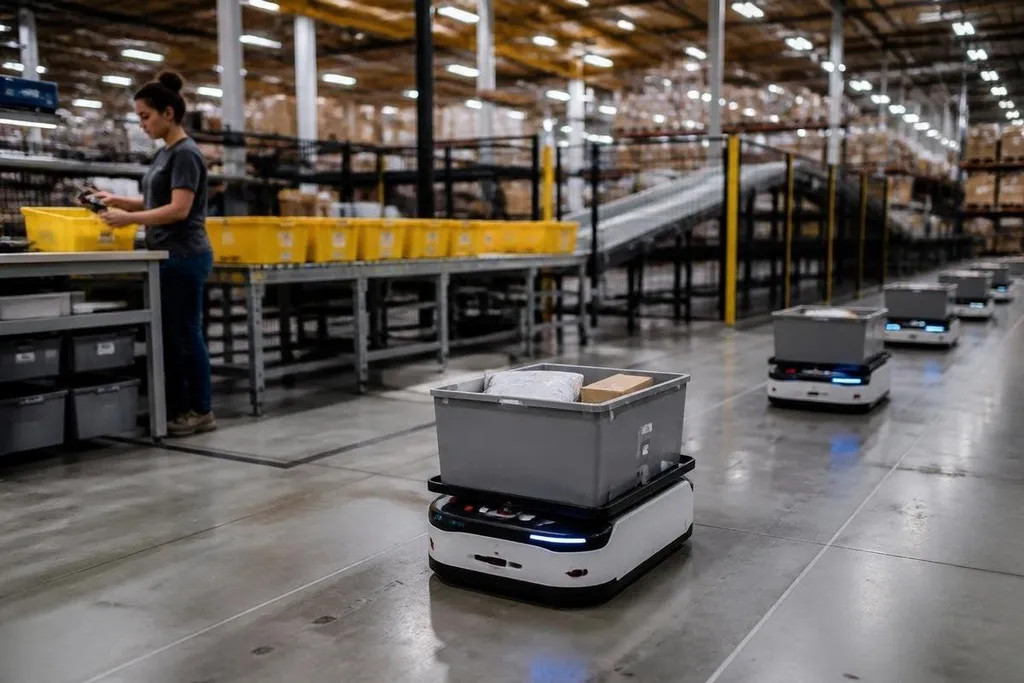
E-commerce robots make money when they remove a repeated task from an order process. The clearest openings sit in warehouses, where people move totes, pick items, sort parcels, and pack orders for hours each day.
- Tote movement can cut walking between storage and packing stations.
- Picking systems can handle items that fit known grip and weight limits.
- Packing robots can measure parcels and place products into cartons.
Start with the task, not the robot
A company does not buy a robot because it has wheels, cameras, or a robotic arm. It buys a result: more orders handled, fewer injuries, lower labor cost, or longer operating hours.
That makes repeated movement a useful place to look. An autonomous mobile robot can carry a tote between storage and a picking station. The robot follows mapped routes, stops for people, and returns for another load. The business earns value from each trip that no longer needs a person to walk across the building.
Picking has a harder path. Products vary in shape, weight, packaging, and location. A robot arm may work well with boxed goods that sit in fixed bins, while soft clothing or mixed items can require more sensing and human help. A company selling picking robots needs to state the item range clearly, because the grip limit shapes the whole business case.
Packing offers another route. A system can measure a product, choose a carton size, add protective material, and send the parcel to shipping. That can reduce wasted box space and make parcel handling more consistent, but the system still needs a clean handoff when an item does not match its expected size.
Business models beyond selling hardware
Selling a robot is one model. E-commerce companies may also pay for installation, software, maintenance, spare parts, or a monthly service contract. Each model changes who carries the cost when the robot stops working.
A robot maker can sell equipment to a warehouse operator. A logistics company can run the equipment for several customers and charge by order, tote, or operating hour.
A software company can connect robots made by different vendors with warehouse management systems. That work depends on open interfaces and reliable data.
Robot leasing can help a company avoid a large purchase. The buyer still needs to check the full term cost, service response, battery replacement, network work, and worker training. A low monthly payment does not fix a poor task fit.
A picking robot’s hourly rate means little if one worker must watch it all shift. Reports on Robot24.com can record the task, site, test date, and staffing plan behind a deployment, so you can price the lease against the labor it still needs before the next section counts the costs.
Where the money can disappear
Robot projects carry costs that sit outside the machine's price. A warehouse may need floor changes, charging points, safety barriers, wireless coverage, software links, and staff training. The site may also need a person who can clear blocked routes or restart a failed task.
The order mix matters too. A warehouse that sells one standard product has a different problem from one that ships thousands of small items in many shapes. Robots tend to fit the first case more easily because the hand positions, routes, and safety checks stay within known limits.
Downtime can erase the expected gain. If one robot blocks a packing lane, the cost reaches beyond that machine. Buyers should ask how the system behaves during a sensor fault, low battery, lost network link, or damaged parcel.
I’d start with tote movement before buying a robot arm. The task is easier to measure, and the warehouse can compare walking time, trips per hour, delays, and worker needs before it takes on harder picking work.
A buyer's decision guide
Use these checks before treating an e-commerce robot as a business opportunity:
- Name the task: record each handoff, walk, lift, scan, and wait.
- Count the work: measure orders, totes, parcels, or operating hours across a normal week.
- Set the limits: list item size, weight, surface, packaging, and grip conditions.
- Price the site: include charging, network changes, safety work, training, service, and spare parts.
- Test failure handling: ask who fixes a blocked route, missed pick, bad scan, or low battery.
- Choose the payment model: compare a purchase, lease, service fee, and per-order charge.
The next useful step is a small trial with one task and a fixed measurement plan. Record the work done by people before the trial, then compare the same measures after the robot runs under normal warehouse conditions. The opportunity is real when the machine keeps working after the demo ends and the numbers still support its cost.